
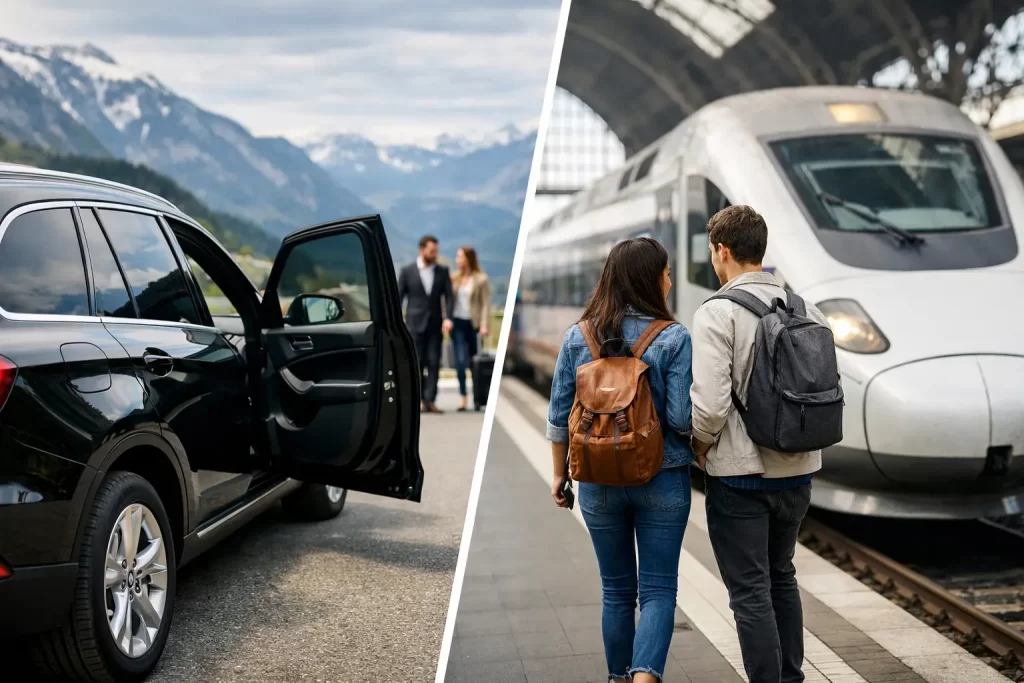
You notice the difference between a train and a private transfer the moment your trip gets even slightly complicated. One suitcase becomes three. One city-center station turns into an airport hotel on the edge of town. One direct route becomes a connection through an unfamiliar station with 12 minutes to change platforms. That is where private transfer vs train Europe stops being a simple price question and becomes a practical travel decision.
For some trips, the train is clearly the right choice. For others, a pre-booked private car is faster in real terms, easier with luggage, and far less stressful. If you are traveling across Central Europe – especially between cities such as Prague, Vienna, Salzburg, Munich, Budapest, Berlin, or Krakow – the best option depends on what kind of trip you are actually taking, not just what the timetable says.
Private transfer vs train Europe: the real difference
On paper, trains often look cheaper and more straightforward. You compare ticket prices, see a rail journey listed at a lower fare, and assume that settles it. But travel between European cities is rarely just station to station.
A train ticket usually covers only the rail segment. You still need to get to the departure station, manage your luggage through the station, make any required connections, and then arrange transport from the arrival station to your hotel, apartment, meeting, or airport. If you are traveling with family, in a group, or with several bags, those extra steps are not minor details. They shape the whole day.
A private transfer works differently. It is door to door, pre-arranged, and built around your route rather than the rail network. Your driver picks you up at your address, helps with luggage, and takes you directly to your destination. For travelers who value simplicity, that difference matters more than a timetable headline.
When the train makes more sense
The train is often a strong option when the route is direct, the stations are central, and you are traveling light. If you are a solo traveler going from one major city center to another, and you are comfortable with rail systems, platforms, and local transit, train travel can be efficient and economical.
It also works well when flexibility is less important than budget. If your schedule matches the available departures and you do not mind fixed times, a train can be perfectly practical. Some travelers also simply enjoy rail travel. They like the scenery, the station atmosphere, and the feeling of moving through Europe by train. That preference is valid.
Still, the train becomes less attractive once your route involves extra transfers, border-region connections, or late arrivals. A trip that seems manageable on a website can feel very different after a flight delay, with children, or after carrying luggage across platforms and staircases.
When a private transfer is the better choice
A private transfer usually makes more sense when convenience, timing, and direct travel matter. That includes early departures, late-night arrivals, hotel pickup, airport drop-off, and trips where the nearest useful train station is not actually close to where you need to be.
This is especially true across Central Europe, where many popular city pairs are well traveled but not always perfectly served by direct rail. Even when trains are available, the total journey can involve a local taxi to the station, waiting time, a train change, and another taxi at the other end. A private transfer cuts out that chain.
Families often benefit most. Managing children, strollers, snacks, passports, and multiple bags through stations is hard work. A private car gives you space, direct routing, and a predictable start and finish. The same applies to small groups. Once you split train fares, local taxis, and baggage handling, a private transfer can become very competitive on total cost.
Business travelers also tend to value the time savings. Not because the road is always faster than the rail line, but because door-to-door transport removes dead time. There is less waiting, less navigating, and less risk of arriving tired before the day has even started.
Cost is not as simple as ticket price
Price comparisons often go wrong because people compare one train ticket with one vehicle price. That is not the real comparison.
The better comparison is total trip cost. For rail, that includes station transfers, possible seat reservations, premium luggage handling if needed, and the time cost of connections or missed trains. For a private transfer, the useful benchmark is the full pre-booked rate for your whole journey.
If two or three people are traveling together, the gap often narrows quickly. For four or more passengers, especially on intercity routes, a private transfer can be surprisingly good value. The numbers make even more sense when the price is fixed in advance and includes tolls and taxes, because there are no last-minute surprises.
That matters for international travelers who want to know the exact cost before booking. Certainty is part of the value, not just the ride itself.
Comfort matters more on longer routes
Comfort sounds like a luxury until you are three hours into a travel day. Then it becomes practical.
Trains can be comfortable, but the experience varies a lot by route, carriage, crowd level, and time of day. You may have limited luggage space, no privacy, busy aisles, and no guarantee that the quiet journey you imagined is what you actually get. During peak periods, rail travel can feel crowded and tiring.
A private transfer gives you your own space. You control the atmosphere. Your bags stay with you. There is no need to watch station boards, protect your seat, or rush off at the right stop. If you are traveling as a couple, family, or small group, the trip feels more private and organized from the start.
For longer journeys between cities such as Prague and Vienna or Prague and Munich, that can change the whole experience. You arrive ready for the next part of your trip instead of needing recovery time.
Luggage, children, and special travel needs
This is where trains often lose ground.
Rail travel is manageable with one small suitcase and a backpack. It gets harder with ski gear, large cases, baby equipment, shopping bags, or anything that needs lifting and moving more than once. Not every station is easy to navigate, and not every connection leaves enough time to move comfortably.
Private transfers are simply better suited to luggage-heavy travel. You can choose a vehicle that fits your passenger count and baggage needs. That might be a sedan for a couple, an MPV for a family, or a minivan for a small group. The practical advantage is obvious – one pickup, one vehicle, one direct trip.
For travelers with mobility concerns, elderly passengers, or anyone who prefers to avoid busy stations, private travel is also more straightforward and less physically demanding.
Reliability depends on the whole journey
People often assume trains are always the more reliable option. Sometimes they are. But reliability should be measured by whether you arrive where you need to be, on time, with minimal disruption.
A train can run on schedule and still leave you with a stressful overall trip because of local transit delays, platform changes, missed connections, or a long final taxi wait. A private transfer removes several of those failure points.
That is why pre-booked service matters. With a company such as Czech Transfer Service, the booking is confirmed in advance, pricing is fixed and all-inclusive, and the driver is English-speaking. That makes the process easier for international travelers who do not want to sort out transport details on arrival. Pre-payment and free cancellation up to 24 hours before pickup also help keep planning simple.
So which should you choose?
If your route is direct, your luggage is light, your schedule is flexible, and the stations are genuinely convenient, train travel is often a sensible choice. It can be cost-effective and efficient for the right type of trip.
If you want door-to-door transport, fixed pricing, less stress, easier luggage handling, and a trip that works around your schedule rather than the rail network, a private transfer is usually the stronger option. That is particularly true for airport connections, family travel, business trips, small groups, and cross-border routes where the train adds extra steps.
The smartest travelers do not ask which option is better in general. They ask which one fits this trip.
If your priority is getting from one address to another with the least hassle, the answer is often clear. Choose the option that removes complications before they start. That is usually the one you will be happiest you booked.